
PAA Anode Binders Research:implying a 2026-2032 CAGR of about 24.4%
クレジット

イラストレーター
PAA Anode Binders Research:implying a 2026-2032 CAGR of about 24.4%
The global market for PAA Anode Binders [PAA Negative Electrode Adhesive] was estimated to be worth US$ 215 million in 2025 and is projected to reach US$ 1004 million, growing at a CAGR of 24.4% from 2026 to 2032.
Global Market Research Publisher QYResearch (QY Research) announces the release of its latest report “PAA Anode Binders [PAA Negative Electrode Adhesive] - Global Market Share and Ranking, Overall Sales and Demand Forecast 2026-2032”. Based on 2025 market situation and impact historical analysis (2021-2025) and forecast calculations (2026-2032), this report provides a comprehensive analysis of the global PAA Anode Binders [PAA Negative Electrode Adhesive] market, including market size, market share, market volume, demand, industry development status, and forecasts for the next few years.
The report provides advanced statistics and information on global market conditions and studies the strategic patterns adopted by renowned players across the globe. As the market is constantly changing, the report explores competition, supply and demand trends, as well as the key factors that contribute to its changing demands across many markets.
【Get a free sample PDF of this report (Including Full TOC, List of Tables & Figures, Chart)】
https://www.qyresearch.com/reports/6451073/paa-anode-binders--paa-negative-electrode-adhesive
PAA anode binders are water-based lithium-ion battery binder materials based on polyacrylic acid (PAA), its salts, and modified polymer systems. They are primarily used in silicon-based and graphite anodes, with selected applications in cathode and separator coating systems. As high-silicon anodes move from laboratory validation toward commercial scale-up and battery supply chains become increasingly localized, PAA anode binders are entering an important transition from formulation trials to large-scale production qualification.
According to QYResearch, the global PAA anode binders market was valued at approximately US$215 million in 2025, is expected to reach about US$271 million in 2026, and is projected to approach US$1,004 million by 2032. This represents a CAGR of approximately 24.4% during 2026–2032. The rapid expansion is driven by high-silicon anode adoption, domestic substitution, and the shift toward water-based electrode processing. However, actual market realization will depend heavily on customer qualification, production ramp-up, product consistency, and pricing dynamics.
【Get a free sample PDF of this report (Including Full TOC, List of Tables & Figures, Chart)】
Core Growth Logic: High-Silicon Anode Scale-Up
The growth of PAA anode binders is not simply a material substitution opportunity against conventional SBR or PVDF systems. The more fundamental driver is the increasing use of silicon-containing anodes, which impose substantially higher requirements on electrode adhesion, mechanical flexibility, structural stability, and swelling management.
Silicon undergoes significant volume changes during lithiation and delithiation, creating challenges for electrode integrity and long-term cycling. PAA-based systems can interact strongly with silicon surfaces and provide robust adhesion, making them particularly suitable for SiOx, silicon-carbon composites, and other high-energy-density anode architectures.
Consequently, the penetration rate of high-silicon anodes in mainstream cells is becoming one of the most important variables for forecasting PAA anode binder demand.
Market Size and Growth Trend
The global PAA anode binders market is projected to expand from approximately US$215 million in 2025 to nearly US$1.0 billion by 2032. The estimated 24.4% CAGR indicates that the market is moving beyond early-stage formulation validation toward broader production qualification.
At this stage, supplier performance is increasingly measured through solids content, molecular-weight control, dispersibility, impurity levels, formulation compatibility, batch consistency, and supply stability. Price remains important, but customers are increasingly evaluating binder performance together with electrode yield, cycle life, processing efficiency, and long-term supply reliability.
Product and Application Structure
General aqueous PAA binders currently form the primary product base, while modified PAA systems with higher solids content, improved dispersion, lower metal impurities, and stronger compatibility with CMC/SBR formulations are gaining attention.
Silicon-based anodes represent the principal growth engine because of their demanding mechanical and electrochemical requirements. Graphite anodes provide a second potential growth curve as manufacturers evaluate aqueous binder systems for process optimization and potential replacement of conventional materials.
Additional opportunities may emerge in cathode edge coating and separator coating applications, although these remain secondary compared with anode applications. This product segmentation indicates that future competition will increasingly depend on formulation engineering rather than standardized PAA supply alone.
Regional Landscape
Mainland China represents the most important scale-up market because it combines extensive anode-material production, lithium-ion battery manufacturing capacity, and strong electric-vehicle and energy-storage demand. The country's integrated battery supply chain provides domestic PAA suppliers with opportunities to accelerate customer qualification and localized substitution.
Japan and South Korea maintain strengths in advanced battery-material development, formulation know-how, premium qualification, and long-term collaboration with major cell manufacturers. Europe and North America are supported by battery supply-chain localization, EV and energy-storage investment, and increasing attention to material safety and sustainable manufacturing processes.
Regional competition is therefore shifting from simple production capacity toward qualification records, technical collaboration, localized service, and mass-production consistency.
Competitive Landscape
The PAA anode binder market features a relatively concentrated competitive structure alongside accelerating domestic substitution. Chinese companies such as Indigo, Blue Ocean Black Stone, Shenzhen Yanyi, Eternal Materials, and Hubei Huitian are expanding their presence among local battery customers.
International suppliers including Arkema, FUJIFILM, and Zeon retain advantages in technology experience, premium material systems, customer qualification, and overseas market coverage. As Chinese battery manufacturers continue to expand their global footprint, the competitive environment is likely to become increasingly international.
The decisive competitive factors are moving toward formulation capability, manufacturing stability, rapid customer response, cost control, and the ability to support customers throughout product development and mass-production qualification.
Industry Chain Analysis
The upstream chain covers acrylic-acid-based raw materials, neutralizing agents, polymerization initiators, functional additives, solvents or water systems, and production equipment. Raw-material purity and polymerization control directly influence molecular weight, viscosity, dispersion, adhesion, and batch stability.
Midstream manufacturers focus on polymer synthesis, modification, formulation, purification, quality control, and packaging. Process consistency is particularly important because minor variations in molecular structure or solids content can affect slurry rheology and electrode processing.
Downstream customers include anode-material producers, lithium-ion battery cell manufacturers, EV battery suppliers, and energy-storage-system manufacturers. The closer integration between binder suppliers and battery customers is increasing the importance of application engineering and joint formulation development.
Opportunities, Constraints and Market Outlook
The strongest opportunities come from high-silicon anode penetration, localized anode-material supply, water-based processing, and expanding EV and ESS battery capacity. These trends could create significant demand elasticity if silicon-anode commercialization accelerates.
At the same time, long qualification cycles, strict batch-to-batch consistency requirements, pricing pressure, and capacity expansion are major constraints. Once new capacity enters the market, competition could intensify rapidly, placing pressure on product prices and supplier margins.
The global PAA anode binders market is projected to approach US$1,004 million by 2032. The most meaningful indicator will therefore not be supplier capacity announcements, but actual penetration of high-silicon anodes in mainstream battery cells and the ability of PAA suppliers to pass long-term validation and obtain repeat orders.
If high-silicon anode scale-up proceeds as expected, PAA anode binders could become one of the most demand-elastic segments within the battery auxiliary-material market.
The report provides a detailed analysis of the market size, growth potential, and key trends for each segment. Through detailed analysis, industry players can identify profit opportunities, develop strategies for specific customer segments, and allocate resources effectively.
The PAA Anode Binders [PAA Negative Electrode Adhesive] market is segmented as below:
By Company
Indigo
Blue Ocean Black Stone
Shenzhen Yanyi New Materials Co., Ltd.
Eternal Materials
Hubei Huitian New Materials Co., Ltd.
Arkema
Fujifilm
Zeon Corporation
Jingrui Electronic Materials Co., Ltd.
Tinci Materials
Lushan New Materials
Wanhua Chemical
Segment by Type
PAA Binder for Graphite Anodes
PAA Binder for Silicon-based Anodes
Segment by Application
Power Batteries
Energy Storage Batteries
Consumer Batteries
Each chapter of the report provides detailed information for readers to further understand the PAA Anode Binders [PAA Negative Electrode Adhesive] market:
Chapter 1: Introduces the report scope of the PAA Anode Binders [PAA Negative Electrode Adhesive] report, global total market size (valve, volume and price). This chapter also provides the market dynamics, latest developments of the market, the driving factors and restrictive factors of the market, the challenges and risks faced by manufacturers in the industry, and the analysis of relevant policies in the industry. (2021-2032)
Chapter 2: Detailed analysis of PAA Anode Binders [PAA Negative Electrode Adhesive] manufacturers competitive landscape, price, sales and revenue market share, latest development plan, merger, and acquisition information, etc. (2021-2026)
Chapter 3: Provides the analysis of various PAA Anode Binders [PAA Negative Electrode Adhesive] market segments by Type, covering the market size and development potential of each market segment, to help readers find the blue ocean market in different market segments. (2021-2032)
Chapter 4: Provides the analysis of various market segments by Application, covering the market size and development potential of each market segment, to help readers find the blue ocean market in different downstream markets.(2021-2032)
Chapter 5: Sales, revenue of PAA Anode Binders [PAA Negative Electrode Adhesive] in regional level. It provides a quantitative analysis of the market size and development potential of each region and introduces the market development, future development prospects, market space, and market size of each country in the world..(2021-2032)
Chapter 6: Sales, revenue of PAA Anode Binders [PAA Negative Electrode Adhesive] in country level. It provides sigmate data by Type, and by Application for each country/region.(2021-2032)
Chapter 7: Provides profiles of key players, introducing the basic situation of the main companies in the market in detail, including product sales, revenue, price, gross margin, product introduction, recent development, etc. (2021-2026)
Chapter 8: Analysis of industrial chain, including the upstream and downstream of the industry.
Chapter 9: Conclusion.
Benefits of purchasing QYResearch report:
Competitive Analysis: QYResearch provides in-depth PAA Anode Binders [PAA Negative Electrode Adhesive] competitive analysis, including information on key company profiles, new entrants, acquisitions, mergers, large market shear, opportunities, and challenges. These analyses provide clients with a comprehensive understanding of market conditions and competitive dynamics, enabling them to develop effective market strategies and maintain their competitive edge.
Industry Analysis: QYResearch provides PAA Anode Binders [PAA Negative Electrode Adhesive] comprehensive industry data and trend analysis, including raw material analysis, market application analysis, product type analysis, market demand analysis, market supply analysis, downstream market analysis, and supply chain analysis.
and trend analysis. These analyses help clients understand the direction of industry development and make informed business decisions.
Market Size: QYResearch provides PAA Anode Binders [PAA Negative Electrode Adhesive] market size analysis, including capacity, production, sales, production value, price, cost, and profit analysis. This data helps clients understand market size and development potential, and is an important reference for business development.
Other relevant reports of QYResearch:
Global PAA Anode Binders [PAA Negative Electrode Adhesive] Market Research Report 2026
Global PAA Anode Binders [PAA Negative Electrode Adhesive] Sales Market Report, Competitive Analysis and Regional Opportunities 2026-2032
Global PAA Anode Binders [PAA Negative Electrode Adhesive] Market Outlook, In‑Depth Analysis & Forecast to 2032
To contact us and get this report: https://www.qyresearch.com/contact-us
About Us:
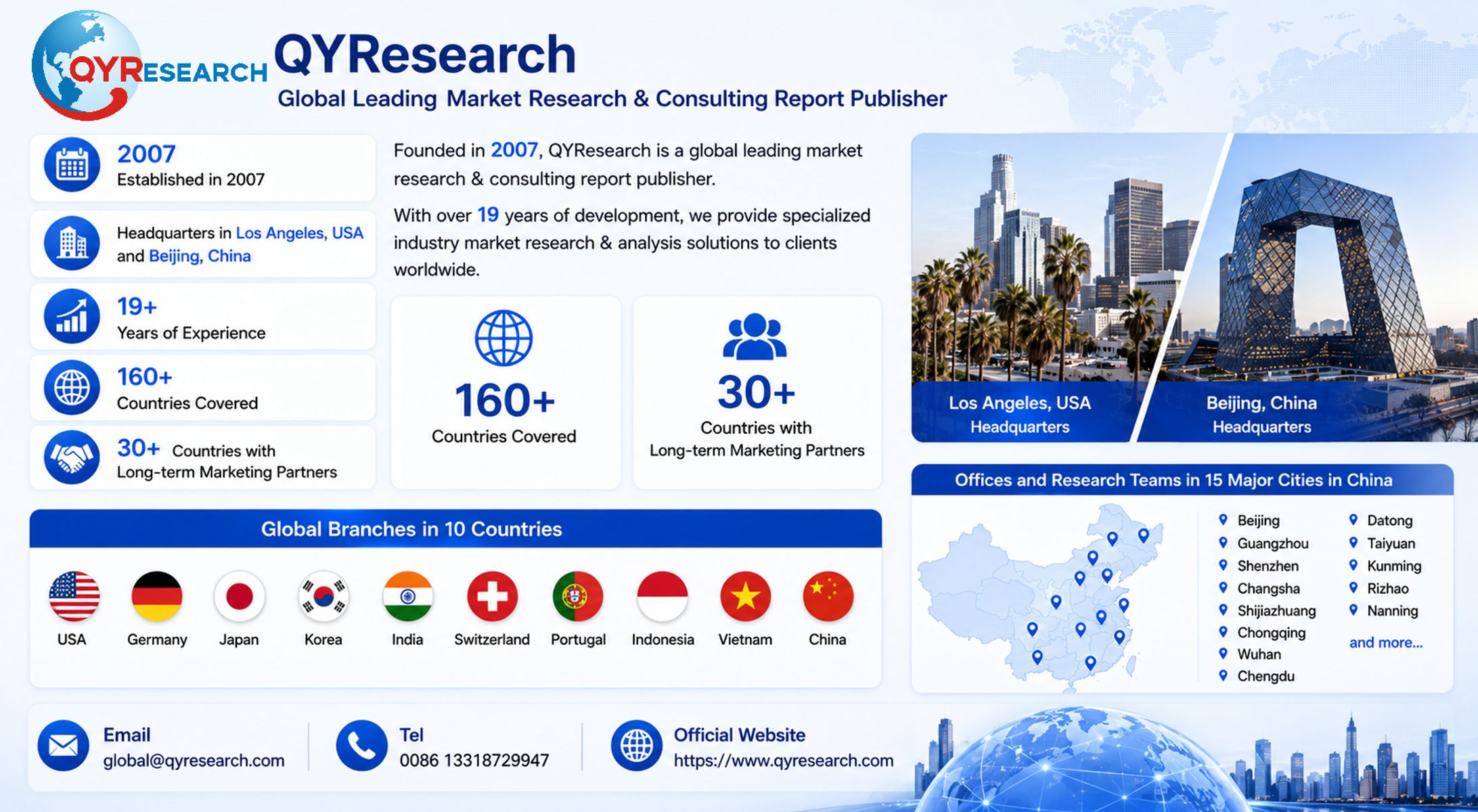
QYResearch founded in California, USA in 2007, which is a leading global market research and consulting company. Our primary business include market research reports, custom reports, commissioned research, IPO consultancy, business plans, etc. With over 19 years of experience and a dedicated research team, we are well placed to provide useful information and data for your business, and we have established offices in 7 countries (include United States, Germany, Switzerland, Japan, Korea, China and India) and business partners in over 30 countries. We have provided industrial information services to more than 60,000 companies in over the world.
Contact Us:
If you have any queries regarding this report or if you would like further information, please contact us:
QY Research Inc.
Add: 17890 Castleton Street Suite 369 City of Industry CA 91748 United States
EN: https://www.qyresearch.com
E-mail: global@qyresearch.com
Tel: 001-626-842-1666(US)
JP: https://www.qyresearch.co.jp
クレジット
イラストレーター


あなたのforiioを無料で作成
PAA Anode Binders Research:implying a 2026-2032 CAGR of about 24.4%
The global market for PAA Anode Binders [PAA Negative Electrode Adhesive] was estimated to be worth US$ 215 million in 2025 and is projected to reach US$ 1004 million, growing at a CAGR of 24.4% from 2026 to 2032.
Global Market Research Publisher QYResearch (QY Research) announces the release of its latest report “PAA Anode Binders [PAA Negative Electrode Adhesive] - Global Market Share and Ranking, Overall Sales and Demand Forecast 2026-2032”. Based on 2025 market situation and impact historical analysis (2021-2025) and forecast calculations (2026-2032), this report provides a comprehensive analysis of the global PAA Anode Binders [PAA Negative Electrode Adhesive] market, including market size, market share, market volume, demand, industry development status, and forecasts for the next few years.
The report provides advanced statistics and information on global market conditions and studies the strategic patterns adopted by renowned players across the globe. As the market is constantly changing, the report explores competition, supply and demand trends, as well as the key factors that contribute to its changing demands across many markets.
【Get a free sample PDF of this report (Including Full TOC, List of Tables & Figures, Chart)】
https://www.qyresearch.com/reports/6451073/paa-anode-binders--paa-negative-electrode-adhesive
PAA anode binders are water-based lithium-ion battery binder materials based on polyacrylic acid (PAA), its salts, and modified polymer systems. They are primarily used in silicon-based and graphite anodes, with selected applications in cathode and separator coating systems. As high-silicon anodes move from laboratory validation toward commercial scale-up and battery supply chains become increasingly localized, PAA anode binders are entering an important transition from formulation trials to large-scale production qualification.
According to QYResearch, the global PAA anode binders market was valued at approximately US$215 million in 2025, is expected to reach about US$271 million in 2026, and is projected to approach US$1,004 million by 2032. This represents a CAGR of approximately 24.4% during 2026–2032. The rapid expansion is driven by high-silicon anode adoption, domestic substitution, and the shift toward water-based electrode processing. However, actual market realization will depend heavily on customer qualification, production ramp-up, product consistency, and pricing dynamics.
【Get a free sample PDF of this report (Including Full TOC, List of Tables & Figures, Chart)】
Core Growth Logic: High-Silicon Anode Scale-Up
The growth of PAA anode binders is not simply a material substitution opportunity against conventional SBR or PVDF systems. The more fundamental driver is the increasing use of silicon-containing anodes, which impose substantially higher requirements on electrode adhesion, mechanical flexibility, structural stability, and swelling management.
Silicon undergoes significant volume changes during lithiation and delithiation, creating challenges for electrode integrity and long-term cycling. PAA-based systems can interact strongly with silicon surfaces and provide robust adhesion, making them particularly suitable for SiOx, silicon-carbon composites, and other high-energy-density anode architectures.
Consequently, the penetration rate of high-silicon anodes in mainstream cells is becoming one of the most important variables for forecasting PAA anode binder demand.
Market Size and Growth Trend
The global PAA anode binders market is projected to expand from approximately US$215 million in 2025 to nearly US$1.0 billion by 2032. The estimated 24.4% CAGR indicates that the market is moving beyond early-stage formulation validation toward broader production qualification.
At this stage, supplier performance is increasingly measured through solids content, molecular-weight control, dispersibility, impurity levels, formulation compatibility, batch consistency, and supply stability. Price remains important, but customers are increasingly evaluating binder performance together with electrode yield, cycle life, processing efficiency, and long-term supply reliability.
Product and Application Structure
General aqueous PAA binders currently form the primary product base, while modified PAA systems with higher solids content, improved dispersion, lower metal impurities, and stronger compatibility with CMC/SBR formulations are gaining attention.
Silicon-based anodes represent the principal growth engine because of their demanding mechanical and electrochemical requirements. Graphite anodes provide a second potential growth curve as manufacturers evaluate aqueous binder systems for process optimization and potential replacement of conventional materials.
Additional opportunities may emerge in cathode edge coating and separator coating applications, although these remain secondary compared with anode applications. This product segmentation indicates that future competition will increasingly depend on formulation engineering rather than standardized PAA supply alone.
Regional Landscape
Mainland China represents the most important scale-up market because it combines extensive anode-material production, lithium-ion battery manufacturing capacity, and strong electric-vehicle and energy-storage demand. The country's integrated battery supply chain provides domestic PAA suppliers with opportunities to accelerate customer qualification and localized substitution.
Japan and South Korea maintain strengths in advanced battery-material development, formulation know-how, premium qualification, and long-term collaboration with major cell manufacturers. Europe and North America are supported by battery supply-chain localization, EV and energy-storage investment, and increasing attention to material safety and sustainable manufacturing processes.
Regional competition is therefore shifting from simple production capacity toward qualification records, technical collaboration, localized service, and mass-production consistency.
Competitive Landscape
The PAA anode binder market features a relatively concentrated competitive structure alongside accelerating domestic substitution. Chinese companies such as Indigo, Blue Ocean Black Stone, Shenzhen Yanyi, Eternal Materials, and Hubei Huitian are expanding their presence among local battery customers.
International suppliers including Arkema, FUJIFILM, and Zeon retain advantages in technology experience, premium material systems, customer qualification, and overseas market coverage. As Chinese battery manufacturers continue to expand their global footprint, the competitive environment is likely to become increasingly international.
The decisive competitive factors are moving toward formulation capability, manufacturing stability, rapid customer response, cost control, and the ability to support customers throughout product development and mass-production qualification.
Industry Chain Analysis
The upstream chain covers acrylic-acid-based raw materials, neutralizing agents, polymerization initiators, functional additives, solvents or water systems, and production equipment. Raw-material purity and polymerization control directly influence molecular weight, viscosity, dispersion, adhesion, and batch stability.
Midstream manufacturers focus on polymer synthesis, modification, formulation, purification, quality control, and packaging. Process consistency is particularly important because minor variations in molecular structure or solids content can affect slurry rheology and electrode processing.
Downstream customers include anode-material producers, lithium-ion battery cell manufacturers, EV battery suppliers, and energy-storage-system manufacturers. The closer integration between binder suppliers and battery customers is increasing the importance of application engineering and joint formulation development.
Opportunities, Constraints and Market Outlook
The strongest opportunities come from high-silicon anode penetration, localized anode-material supply, water-based processing, and expanding EV and ESS battery capacity. These trends could create significant demand elasticity if silicon-anode commercialization accelerates.
At the same time, long qualification cycles, strict batch-to-batch consistency requirements, pricing pressure, and capacity expansion are major constraints. Once new capacity enters the market, competition could intensify rapidly, placing pressure on product prices and supplier margins.
The global PAA anode binders market is projected to approach US$1,004 million by 2032. The most meaningful indicator will therefore not be supplier capacity announcements, but actual penetration of high-silicon anodes in mainstream battery cells and the ability of PAA suppliers to pass long-term validation and obtain repeat orders.
If high-silicon anode scale-up proceeds as expected, PAA anode binders could become one of the most demand-elastic segments within the battery auxiliary-material market.
The report provides a detailed analysis of the market size, growth potential, and key trends for each segment. Through detailed analysis, industry players can identify profit opportunities, develop strategies for specific customer segments, and allocate resources effectively.
The PAA Anode Binders [PAA Negative Electrode Adhesive] market is segmented as below:
By Company
Indigo
Blue Ocean Black Stone
Shenzhen Yanyi New Materials Co., Ltd.
Eternal Materials
Hubei Huitian New Materials Co., Ltd.
Arkema
Fujifilm
Zeon Corporation
Jingrui Electronic Materials Co., Ltd.
Tinci Materials
Lushan New Materials
Wanhua Chemical
Segment by Type
PAA Binder for Graphite Anodes
PAA Binder for Silicon-based Anodes
Segment by Application
Power Batteries
Energy Storage Batteries
Consumer Batteries
Each chapter of the report provides detailed information for readers to further understand the PAA Anode Binders [PAA Negative Electrode Adhesive] market:
Chapter 1: Introduces the report scope of the PAA Anode Binders [PAA Negative Electrode Adhesive] report, global total market size (valve, volume and price). This chapter also provides the market dynamics, latest developments of the market, the driving factors and restrictive factors of the market, the challenges and risks faced by manufacturers in the industry, and the analysis of relevant policies in the industry. (2021-2032)
Chapter 2: Detailed analysis of PAA Anode Binders [PAA Negative Electrode Adhesive] manufacturers competitive landscape, price, sales and revenue market share, latest development plan, merger, and acquisition information, etc. (2021-2026)
Chapter 3: Provides the analysis of various PAA Anode Binders [PAA Negative Electrode Adhesive] market segments by Type, covering the market size and development potential of each market segment, to help readers find the blue ocean market in different market segments. (2021-2032)
Chapter 4: Provides the analysis of various market segments by Application, covering the market size and development potential of each market segment, to help readers find the blue ocean market in different downstream markets.(2021-2032)
Chapter 5: Sales, revenue of PAA Anode Binders [PAA Negative Electrode Adhesive] in regional level. It provides a quantitative analysis of the market size and development potential of each region and introduces the market development, future development prospects, market space, and market size of each country in the world..(2021-2032)
Chapter 6: Sales, revenue of PAA Anode Binders [PAA Negative Electrode Adhesive] in country level. It provides sigmate data by Type, and by Application for each country/region.(2021-2032)
Chapter 7: Provides profiles of key players, introducing the basic situation of the main companies in the market in detail, including product sales, revenue, price, gross margin, product introduction, recent development, etc. (2021-2026)
Chapter 8: Analysis of industrial chain, including the upstream and downstream of the industry.
Chapter 9: Conclusion.
Benefits of purchasing QYResearch report:
Competitive Analysis: QYResearch provides in-depth PAA Anode Binders [PAA Negative Electrode Adhesive] competitive analysis, including information on key company profiles, new entrants, acquisitions, mergers, large market shear, opportunities, and challenges. These analyses provide clients with a comprehensive understanding of market conditions and competitive dynamics, enabling them to develop effective market strategies and maintain their competitive edge.
Industry Analysis: QYResearch provides PAA Anode Binders [PAA Negative Electrode Adhesive] comprehensive industry data and trend analysis, including raw material analysis, market application analysis, product type analysis, market demand analysis, market supply analysis, downstream market analysis, and supply chain analysis.
and trend analysis. These analyses help clients understand the direction of industry development and make informed business decisions.
Market Size: QYResearch provides PAA Anode Binders [PAA Negative Electrode Adhesive] market size analysis, including capacity, production, sales, production value, price, cost, and profit analysis. This data helps clients understand market size and development potential, and is an important reference for business development.
Other relevant reports of QYResearch:
Global PAA Anode Binders [PAA Negative Electrode Adhesive] Market Research Report 2026
Global PAA Anode Binders [PAA Negative Electrode Adhesive] Sales Market Report, Competitive Analysis and Regional Opportunities 2026-2032
Global PAA Anode Binders [PAA Negative Electrode Adhesive] Market Outlook, In‑Depth Analysis & Forecast to 2032
To contact us and get this report: https://www.qyresearch.com/contact-us
About Us:
QYResearch founded in California, USA in 2007, which is a leading global market research and consulting company. Our primary business include market research reports, custom reports, commissioned research, IPO consultancy, business plans, etc. With over 19 years of experience and a dedicated research team, we are well placed to provide useful information and data for your business, and we have established offices in 7 countries (include United States, Germany, Switzerland, Japan, Korea, China and India) and business partners in over 30 countries. We have provided industrial information services to more than 60,000 companies in over the world.
Contact Us:
If you have any queries regarding this report or if you would like further information, please contact us:
QY Research Inc.
Add: 17890 Castleton Street Suite 369 City of Industry CA 91748 United States
EN: https://www.qyresearch.com
E-mail: global@qyresearch.com
Tel: 001-626-842-1666(US)
JP: https://www.qyresearch.co.jp
クレジット
イラストレーター